


Racking Load Notices – Why They Are Important

The Importance of Unambiguous Pallet Racking Signs
In any working environment, you need to implement best practice that ensures everyone stays safe. Yet when that setting is a fast-moving warehouse - with vehicles and automation constantly on the move and tonnes of heavy stock held on racking – meeting exacting measures becomes even more important.When considering the safety of your racking, it is essential to provide training on working safely in areas with the storage equipment, a layout designed for your operations, and regular inspections to ensure everything functions as intended. However, did you know your racking also requires clear signage?In our blog, we look at why this signage is needed and how it keeps your warehouse safe.Why are notices important in the warehouse?
Most warehouse health and safety incidents involving racking occur because of one of three problems: poor design and installation, failing to inspect the structure, and incorrect loading practices. While most warehouse owners recognise the link between racking working safely and the first two items on this list, the correct loading of the structure is sometimes overlooked.There are limitations on the amount of weight your racking can carry. If the equipment is continuously overloaded, it will collapse. The last thing you want is for a racking loaded with tonnes of stock to suddenly collapse while your employees are working underneath.Of course, one of the problems when working on the warehouse floor is that each run of racking can be designed to hold a different weight. If you have a warehouse with 20 or more racking runs, it would be impossible for your employees to remember the requirements for each bay. To keep your racking stays safe, the HSE recommends that “storage racking should have a clear, unambiguous notice securely fixed to it.” This safety sign, known as a Load Notice, provides everyone working in that section with a clear and easy-to-understand explanation of the rack’s loading capacity.

Is it a legal requirement to have a load notice on your racking?
Racking and shelving are considered as work equipment and therefore are covered by the Provision and Use of Work Equipment Regulations (PUWER), which requires, amongst other things:- The equipment should be inspected and maintained in good working condition.
- That people operating work equipment are given adequate training in the correct use of the equipment.
- That employees are given the necessary health and safety information.
What should be on a SEMA load notice?
Not every Load Notice will look the same. However, as a good point of reference turn to HSG76 Warehousing and Storage: A Guide to Health and Safety which shows an example of a typical sign and references the SEMA Load Notice.The SEMA Load Notice is split into three informative sections.
General Information
This part of the Load Notice acts as a reminder of general safety instructions. This is broken into six key instructional notices:
Warning - Racking Inspections
Inspections play a crucial role in keeping your racking safe and in good working order by quickly identifying if there is damage to the structure. Training should be provided to employees to provide the skills required to identify damage accurately.Click here to find out about the correct racking inspection steps.

Mandatory Instruction - Racking damage
The second is an instruction to report any damage found on the racking. The sooner you identify an issue with the racking, the quicker you can get the structure repaired and reduce ongoing repair costs. It also enables you to remove the damaged racking section if required while repairs are conducted before being inspected and signed back into use.

Prohibition - racking alterations
The third section is a prohibition which warns warehouse owners and managers against making any uncertified alterations to the racking. Any required alterations should only be made after receiving approval and support from the racking supplier.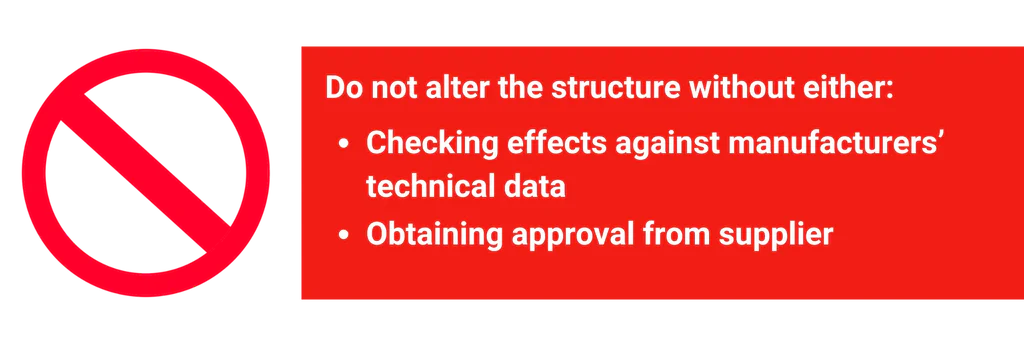

Prohibition - climbing the racking
Racking and shelving are not intended to be climbed upon and the equipment could topple over if this were to happen. Ensure you provide training to instruct employees on how to work and act safely around the racking.

Warning - sources of information
The fifth area advises you to refer to the SEMA Code of Practice for the use of Static Pallet Racking if you require detailed information. This Code provides you with information on the safe design, installation, use and maintenance of adjustable pallet racking, drive-in, and drive-through racking.You can download your copy of the SEMA Code of Practice here.

Warning - sources of information
The final message instructs you to speak to your supplier if you have a query. They know the limitations of your equipment and are the best people to speak to if there is a problem.

The Specific Information Section
The information provided in this section shows the safe working load of the bay, the position of weight and pallets and the limiting weight of all the pallets supported by beams added together.The diagram here shows the following:- The rectangles on the top three shelves show the number and weight of pallets that can be placed on the beams.
- The Bay Load triangle at the bottom shows the limiting weight of all the pallets supported by the beams added together.
The Administrative Information Section
This section contains quick-to-find information on the supplier of the racking, including address and main contact number. Any damage beyond your ability to repair should be referred to the supplier.Be aware that the SEMA Load Notice should only show three relevant logos:- SEMA Approved Manufacturer – Full Member on racking manufactured and installed by a manufacturing member
- SEMA Approved Member and SEMA Approved Member – Advanced where the racking has been manufactured and supplied by a SEMA Approved Manufacturing – Full Member.

How should I load the racking?
While the Load Notice provides you with the information needed for the total weight you can place on the beams, there can still be confusion about how to place the loads on the racking. A question we are frequently asked at SEMA is:"If I have 2 lots of 1000kg pallets per beam level and I have 4 beam levels, is the safe bay load 8000kg?“The answer is “Not necessarily”. In this example, we show how to interpret the load information.In our diagram, most pallets weigh between 500kg and 800kg, but there are also a small number of 1000kg pallets.For ease of use, the warehouse operator wants to store the 1000kg anywhere (hence all beams designed for 2×1000kg pallets) but, for an economical rack, not all the 1000kg pallets are put in the same place.So, assume that our rack has 4 beam levels.- Level 4 2 x 500kg
- Level 3 2 x 1000kg
- Level 2 2 x 650kg
- Level 1 2 x 350 kg

Max Pallet Bay Load
=1000kg OK=5000kg OK
The rack illustration here with 4 beam levels shows a safe bay load totalling 5000kg, not 8000kg. Remember that the loads must be less than BOTH the safe beam loads AND the safe bay load!
Load Notices Checklist
It doesn’t matter what size warehouse you have; if you are storing loads on a racked storage installation, you should provide clear notifications for anyone working on that installation.As a minimum, you should:✓ Check all notices are in place and can be clearly read – this should be a regular function for your inspection team.✓ Any notices that have faded or been damaged should be fixed or, ideally, replaced.✓ Ensure staff know how to order replacement notices, and how to check that the information provided is still relevant.✓ Provide training to ensure your employees understand how to read and understand a racking notice is also essential.✓ Check that the rack is being used within the limits and constraints of the safe working load listed on the load notice. Where it isn’t – remove any overstock carefully and investigate the reasons for the breach.✓ During your Expert Inspection, the inspector should look out for the Load Notice and check that loading practices follow the sign. Their report should identify if there are any loading problems or if the load notice is incorrect or missing.If you would like more information on the SEMA Load Notice, you can watch our video or head over to our Load Notices page.
SEMA Load Notice Signs: Frequently Asked Questions
How often should you update a Load Notice?
You should update your load notices every time you update or modify the racking. The load notice should be a quick reference guide to the racking it is attached to – providing essential and accurate information. If a notice becomes outdated it can lead to a misuse of the racking and therefore increase the likelihood of a serious incident.Do you need to inspect racking installations?
It is a requirement that racking is inspected on a regular basis. This includes Visual Inspections by a trained member of your team and an Expert Inspection by a trained professional, such as a SEMA Approved Racking Inspector (SARI). These inspections should check the racking is in good repair, is being used and loaded correctly and has an up-to-date load notice.
What does the Health and Safety Executive (HSE) say about Load Notices?
The HSE requires that racking has a” clear unambiguous notice fixed to it”, which states safe working load and any specified load capacities. The load notice should also give instructions on the general usage of the racking the notice is affixed to. Full information can be found here on Warehouse and Storage or here for Safety Signs and Signals.Is it a legal requirement to follow the format of the SEMA Load notice?
The load notice is a safety sign and, as well as giving information about the Safe Working Load (SWL) of the racking, also gives important instructions and information about the general usage of racking structures. As the load notice is a safety sign, it must comply with safety sign legislation, i.e., the Health & Safety (Safety Signs and Signals) Regulations 1996 and these regulations require that the safety sign must follow certain rules, for example, with respect to the shape and colour of the sign.The SEMA load notice is the easiest way for an employer to:- Comply with HSE recommendations
- Satisfy their legal obligation to supply the information about the safe operation of the racking
- Follow the safety sign legislation
Is it OK for the load notice to be in black and white?
The weight load notice is a safety sign and, if fitted after 1996, must comply with safety sign legislation i.e. the Health & Safety (Safety Signs and Signals) Regulations 1996. These regulations require that the safety sign must follow certain rules, for example, with respect to the shape and colour of the sign.Therefore, the SEMA load notice must be in colour. A SEMA Approved Rack Inspector (SARI) will categorize a monochrome load notice as an Amber risk.If I have racking sections with different beam lengths within the same run, should I have more than one load notice?
A Load Notice should provide enough information to ensure the rack is used in accordance with the intentions of the racking designer. If you have racking with different configurations, you can give this information by either providing a different load notice for each configuration. The other option is to use a weight Load Notice that gives an acceptable solution for all the configurations – an engineer might call this a “conservative” or “lower-bound solution”.What is the approved way to fit a load notice?
The recommended way to fit a load notice depends upon the product to which you are fitting the Load Notice.- Adjustable pallet racking - it is a common practice to fit the load notice to the frame bracing
- Shelving - it will often be fitted to the shelving frame
- Cantilever racking - the notice will typically be fitted to the column
- Mezzanine floor - a main beam on the perimeter of the floor.
